Reconstruction results
What CryoGEN / CryoWGEN actually achieve on real cryo-ET datasets — the headline results and metrics.
The other pages explain the methods themselves — casting missing-wedge restoration as a Bayesian inverse problem and solving it with statistical machine learning. This page takes the other view and collects what these methods actually produce: what they do on real cryo-ET data, and where they help. (Full figures and tables are in the papers [1][2].)
Validated on real data
CryoGEN has been validated on real biological datasets, including immature HIV-1 virions and ribosomes. From each tomogram corrupted by noise and the missing wedge, it reconstructs a more isotropic, structurally more complete volume — and does so with no ground-truth labels.
- More isotropic. Conventional pipelines leave structure stretched along the missing direction; CryoGEN’s energy prior (and, later, optimal transport) markedly reduces that anisotropy, restoring detail along the smeared vertical axis.
- No recursive subtomogram averaging. The classical route repeatedly aligns and averages many copies to raise SNR and fill the wedge; CryoGEN folds this into a single self-supervised reconstruction, which is why training takes markedly less time.
- More complete, more interpretable. Reconstructed volumes are more coherent across membranes and subunits, easing downstream picking and interpretation.
- Quantified uncertainty (CryoWGEN). With entropic regularization added, CryoWGEN returns not one volume but a family of reconstructions — and the spread of that family is the missing-wedge uncertainty, made readable.
Key result figure
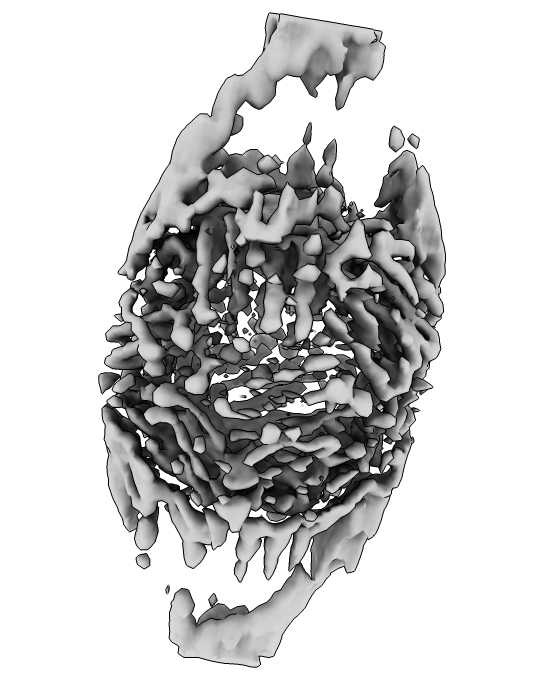 WBP (artifacts)
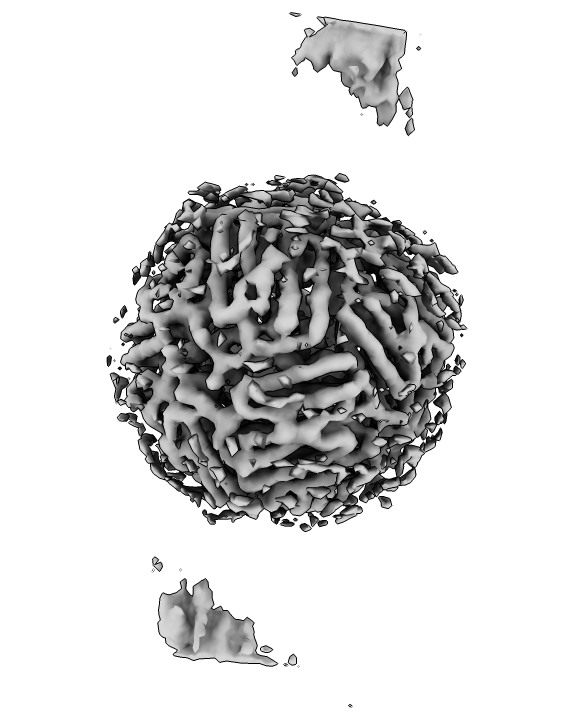 IsoNet
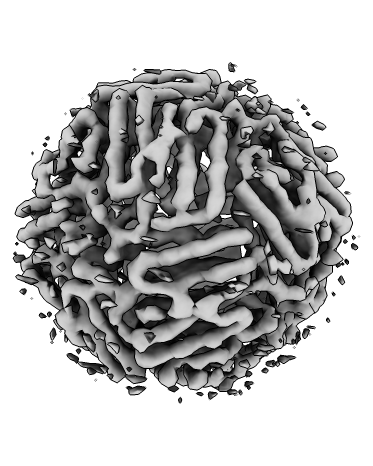 CryoGEN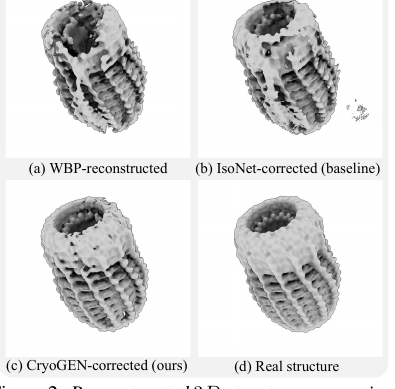
Quantitative comparison
On synthetic data with known ground truth (sphere, prism, Vipp1 assembly), CryoGEN clearly beats the baselines on both PSNR and SSIM (higher is better):
| Data state | Sphere PSNR | Sphere SSIM | Prism PSNR | Prism SSIM | Vipp1 PSNR | Vipp1 SSIM |
|---|---|---|---|---|---|---|
| Corrupted | 21.12 | 0.8113 | 14.82 | 0.6931 | 26.68 | 0.8000 |
| IsoNet | 22.98 | 0.8770 | 19.11 | 0.8857 | 27.12 | 0.8191 |
| DeepDeWedge | 23.17 | 0.8824 | 21.10 | 0.9278 | 28.75 | 0.8758 |
| CryoGEN | 29.19 | 0.9706 | 32.69 | 0.9949 | 30.65 | 0.9199 |
Data from CryoGEN (ICLR 2025), Table 1.
The figures and table on this page are from the published CryoGEN paper [1] (see the references at the end); CryoGEN-II is listed in reference [2]. To render your own .mrc volume into 3-D figures like these, see the software & visualization tutorial.
References
- Yunfei Teng, Yuxuan Ren, Kai Chen, Xi Chen, Zhaoming Chen, Qiwei Ye. CryoGEN: Generative Energy-based Models for Cryogenic Electron Tomography Reconstruction. International Conference on Learning Representations (ICLR), 2025. openreview.net/forum?id=uOb7rij7sR
- Yunfei Teng et al. CryoGEN-II: Cryogenic Electron Tomography Reconstruction via Generative Network. CVPR 2026 Workshops (VISION). openaccess.thecvf.com